















Is your dog intentionally bad?
"My dog, Chester, tears things up when I'm away at work. Today it was the drapes! I know he's doing this to get back at me for leaving him alone all day. When I come home he looks guilty and cowers."
Read More
Search blog
Learn why dogs pull on the leash, how fear, excitement, frustration, and reactivity affect walks, and which humane strategies can help.
Discover eight things your dog wishes you understood about your voice, mood, routines, aging, forgiveness, and the bond you share.
Five dog-training practices that concern canine behavior consultant Scott Sheaffer, from quick fixes and aversive tools to working beyond one's expertise.
Last time I talked about five things dog owners do that drive me crazy. Now it's the trainers' turn.
From “guaranteed” board-and-train fixes to shock collars, aggression cases, trying to do everything, and failing to keep learning, here are five things within my own profession that I think deserve a closer look.
Discover five common dog-owner habits that create stress, confusion, and behavior problems, plus humane, practical ways to help your dog succeed.
Learn the signs of separation anxiety in dogs, how to tell it from boredom, and the practical, humane steps that can help your dog feel safer alone.
Does your dog bark and lunge at other dogs on walks? Learn why this behavior happens, what it really means, common mistakes to avoid, and how behavior modification can help.
A true story about a loving dog owner named Tim, a rescue dog named Buddy that repeatedly bit him, and the surprising discovery that changed everything. Learn why understanding canine body language can prevent bites and strengthen your relationship with your dog.
Why do some dogs with aggression, fear, anxiety, and reactivity improve while others struggle? Dog behaviorist Scott Sheaffer explains the four owner-related factors that strongly predict success in difficult canine behavior cases.
Why do some dogs become aggressive? Learn the real causes behind aggression, including fear, anxiety, pain, frustration, genetics, and learned behavior.
Most dog behavior issues aren’t obedience problems; they’re misunderstood dog behavioral patterns. Learn what you’re missing and how it affects your dog’s behavior.
Some common dog training advice sounds right—but actually makes behavior worse. Learn the 3 biggest mistakes and what to do instead.
Learn why dogs bark at the doorbell, how fear and window barking can strengthen territorial reactions, and what you can do to make arrivals calmer and safer.
Learn why dogs pull on the leash, how fear, excitement, frustration, and reactivity affect walks, and which humane strategies can help.
Discover eight things your dog wishes you understood about your voice, mood, routines, aging, forgiveness, and the bond you share.
Five dog-training practices that concern canine behavior consultant Scott Sheaffer, from quick fixes and aversive tools to working beyond one's expertise.
Last time I talked about five things dog owners do that drive me crazy. Now it's the trainers' turn.
From “guaranteed” board-and-train fixes to shock collars, aggression cases, trying to do everything, and failing to keep learning, here are five things within my own profession that I think deserve a closer look.
Discover five common dog-owner habits that create stress, confusion, and behavior problems, plus humane, practical ways to help your dog succeed.
Learn the signs of separation anxiety in dogs, how to tell it from boredom, and the practical, humane steps that can help your dog feel safer alone.
Does your dog bark and lunge at other dogs on walks? Learn why this behavior happens, what it really means, common mistakes to avoid, and how behavior modification can help.
A true story about a loving dog owner named Tim, a rescue dog named Buddy that repeatedly bit him, and the surprising discovery that changed everything. Learn why understanding canine body language can prevent bites and strengthen your relationship with your dog.
Why do some dogs with aggression, fear, anxiety, and reactivity improve while others struggle? Dog behaviorist Scott Sheaffer explains the four owner-related factors that strongly predict success in difficult canine behavior cases.
Why do some dogs become aggressive? Learn the real causes behind aggression, including fear, anxiety, pain, frustration, genetics, and learned behavior.
Most dog behavior issues aren’t obedience problems; they’re misunderstood dog behavioral patterns. Learn what you’re missing and how it affects your dog’s behavior.
Some common dog training advice sounds right—but actually makes behavior worse. Learn the 3 biggest mistakes and what to do instead.
Discover how Dogosterone and canine HRT can resolve fear-based behavior, anxiety, and mobility issues in neutered male dogs. Is your dog hormonally imbalanced?
Dog owners often unintentionally cue fear and aggression in their dogs. Learn how subtle human behaviors can trigger reactivity—and what to do instead.
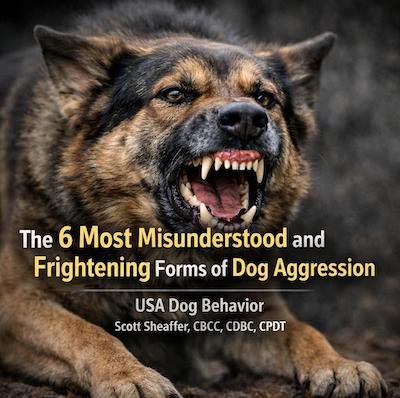
Discover six rare and often misunderstood types of dog aggression, including sleep startle, redirected aggression, and predatory behavior toward humans. Learn why professional help is critical.
Do dogs go to heaven? A pan-religious look at what Christianity, Islam, Judaism, and Eastern traditions say about pets and the afterlife, plus personal reflections on grief, the Rainbow Bridge, and the book Dog Heaven by Cynthia Rylant.
Do dogs know when another dog dies? Learn how dogs perceive death, why they react differently, and how to help surviving dogs adjust after a loss.
Uncover the truth behind dog aggression. Learn why barking, lunging, or snapping is a symptom of fear, not a "mean" personality. Discover the 7 common types of dog aggression and how understanding triggers leads to effective behavior modification, not just labeling.
Worried about your dog and new baby? Discover the reassuring truth: dogs rarely see babies as prey. Learn the key safety periods, how dogs truly perceive infants, and actionable steps for a harmonious home.
Standard dog training often worsens fear and anxiety in sensitive dogs. Learn why obedience-based methods fail anxious dogs—and what actually helps.
Is your dog bored or anxious? Learn why 'giving your dog a job' is the key to channeling natural instincts, stopping bad behavior, and creating a happier, more fulfilled canine companion. Practical tips inside.
Bringing home a new dog is exciting, but first-time owners often discover the learning curve is steeper than they expected. After working with hundreds of families, I’ve noticed I approach first-time owners very differently than experienced ones — not because they aren’t intelligent, lack commitment or care, but because they’re working from assumptions that just don’t match how dogs actually learn.
We’ve all seen them—the modern “training” collars that promise a quick fix for all kinds of dog behavior problems. These collars are really just old-school shock collars (also called e-collars) with a built-in buzzer. While the electric shock function is increasingly recognized as aversive and inhumane, many well-intentioned dog owners are drawn to the “buzzer” or “vibration-only” mode. It seems like such a harmless beep or gentle nudge, a simple way to get your dog’s attention.
Barking is one of the most natural things a dog can do—but when it becomes constant in the backyard, it can strain relationships with neighbors and even cause stress for the dog. The key is to understand why your dog is barking and then take steps to make things quieter and calmer for everyone.
Here are eight ways to stop your dog’s backyard barking:
You’ve seen it a hundred times: one minute, your dog is a perfect angel. The next, they’re a blur of fur, tearing laps around the coffee table, skidding across the floor with a wild look in their eyes. It’s a scene of pure, unbridled chaos… and it’s completely normal.
Aggression is the number-one reason dog owners reach out to me. It’s also one of the most emotionally charged and misunderstood behavior problems. When someone says, “My dog bit me,” or “My dog bit someone,” fear and frustration often take over—and myths quickly fill the gaps where knowledge is missing.
People often ask me, “Scott, what’s the number one thing I should pay attention to in my dog’s behavior?” It’s a fair question. As dog owners, we’re told to keep up with diet, exercise, training, socialization, enrichment, vet visits, and the list goes on and on. All of that matters.
When people ask me, “Who makes the best dog owner?” they usually expect me to name a type of person. Maybe someone who works from home or someone with a big fenced yard. Maybe they’re thinking about people who had dogs as kids and grew up knowing all the basics.
But the truth is, none of those things guarantee success. I’ve seen dogs thrive in apartments and struggle in sprawling houses with massive backyards. I’ve met first-time dog owners who completely turned a difficult case around, and I’ve seen seasoned dog people miss the mark.
When a dog shows aggression, it’s natural to want the problem solved quickly. Many owners, hoping for a fresh start, turn to “board and train” programs—where a dog lives at a training facility for days or weeks, receiving daily sessions with a trainer.
It sounds ideal: the trainer “fixes” the problem while you go about life, and you get your dog back transformed. Unfortunately, for aggression cases, the reality can be far more complicated—and in some cases, harmful.
I want to talk about something a lot of dog owners overlook, but it can make a huge difference in housetraining and behavior issues—properly cleaning up dog accidents. Whether you're dealing with a young puppy or a dog who’s marking in the house, the way you clean up after them matters more than most people realize.
Why Scent Matters More Than the Mess
When dogs eliminate inside, it’s not just an accident; it’s communication. Dogs use scent the way we use text messages. Whether urine or feces, it leaves a calling card: “Hey, this is a place where I go.” And if that message doesn’t get fully erased, your dog might keep going back and “resending” that message.
About ScottScott Sheaffer, CBCC-KA, CDBC, CPDT-KA, is a certified canine behavior consultant specializing in the assessment of serious canine behavior problems. Learn More |
Subscribe (Free) to Scott's BlogExplore & Subscribe |
"My dog, Chester, tears things up when I'm away at work. Today it was the drapes! I know he's doing this to get back at me for leaving him alone all day. When I come home he looks guilty and cowers."
Read MoreAs a professional dog behavior specialist, I long ago made the decision not to use prong, choke or shock collars. Let me tell you how I reached that decision.
Read MoreMen's Health magazine recently ran an article with some interesting facts about men and their dogs. Here a few of the more interesting. The percentage of men who don't have a dog, but wish they did is 88%.
Read MoreAs a dog trainer and behavior specialist, I'm frequently asked the following questions. "What do you think are the best breeds for a family dog?" Basset Hound - Friendly to people and pets - great with children too. Get one from rescue.
Read MoreBelow you'll find some old and familiar dog training terms that in recent years have become somewhat outdated in some circles. These old terms are candidates for an update in light of what we've learned in the last 20 years about dog behavior. Read the following and see what you think.
Read MorePuppy mills (also known as commercial breeders) see puppies more as "livestock" and breed them in large quantities and as economically as possible - an estimated 4 million every year in the US, which sadly equates to the number of dogs euthanized in US shelters annually.
Read MoreWhether you love this TV series or take issue with its methods, I believe it has actually been a net plus for dogs with behavior issues. Why? It has brought attention to the fact that dogs can have behavioral issues that negatively impact the owner's and dog's quality of life - issues that can be addressed by qualified professionals.
Read MoreI've received two notable dog bites in my dog training career:
Read MoreI recently saw this bit of dog training wisdom on the Internet, "[When] dogs pull on a leash they are being aggressive... To stop this behavior...use a choke collar and every time the dog pulls..."
Read MoreDogs are primarily nonverbal communicators. They use their bodies to exchange information with their own species, and they attempt to do the same with humans. While not perfect, our increasing understanding of their communication methods makes it possible for us to better connect with them.
Read MoreI’ve ranked 9 types of popular dog collars below starting with my least favorite (#9) and ending with my favorite (#1).
Read MoreIs your dog Mr. Wonderful off-leash and a handful when on-leash? This seems counterintuitive. When your dog is connected to you by a leash, you would think his behavior would be better than when off-leash. Not always the case.
Read MoreDog aggression is a common and serious issue - and is on the rise. One of the possible reasons for this is that dogs, in general, have less interaction with other dogs and humans than they did in past decades (dog parks notwithstanding). I don’t want to oversimplify here, but too little socialization isn’t good for a dog.
Read MoreNo one can guarantee that a dog, even your own, will not bite your child. Some dog owners think their Max would never hurt a flea, much less bite their own child. Remember that dogs are animals and, given the right circumstances, may respond to your child by biting.
Read MoreIn my private dog training practice I am frequently asked what the most common dog ownership issues are. I’ve prepared a list below of the top 10 that I regularly observe, but, before you read my list, remember there is no such thing as a perfect dog owner – including myself. We are all constantly learning to be better stewards of these magnificent animals.
Read MoreWith the wide variety of dog trainers available and the differing skills and educational levels, you will no doubt encounter a diverse set of opinions when talking to trainers, reading their web sites and getting opinions from former clients, friends, and others.
Read More
Learn why dogs bark at the doorbell, how fear and window barking can strengthen territorial reactions, and what you can do to make arrivals calmer and safer.