The Job Your Dog Is Begging For: How to Channel Instinct into Happiness
What is a dog’s “job?”
For the audio version of these blog posts, tune into the USA Dog Behavior Podcast.
You provide love, food, and walks. So why does your dog still seem restless, bark at nothing, or redecorate your couch with their teeth? The answer might be simpler than you think: your dog is unemployed. Unemployment creates restlessness in humans and dogs.
In the modern world, we’ve perfected physical exercise for our dogs but often neglect a deeper need: mental enrichment and purpose. "Giving your dog a job" isn't about putting them to work—it's about fulfilling their innate, instinctual drives. This is the missing piece for transforming boredom and anxiety into focus and happiness.
Before I go any further, let me clarify something. “Job” does not mean filling a doggie backpack with bricks and letting your dog walk around with it. Can you imagine putting a backpack filled with bricks on a human teenager and expecting it to fulfill their need for a mentally stimulating activity? So, please disabuse yourself of this made-for-TV dog training backpack idea that is absolutely silly. I’m going to explain what a real “job” is below.
Why Instincts Without an Outlet Lead to Trouble
Dogs were bred for specific purposes: herding, retrieving, guarding, and hunting (all dogs are hunters, actually). Without a structured channel, these powerful instincts don't disappear; they get redirected. A herding dog might nip at children or chase bikes. A retriever might obsessively carry and destroy your shoes. A scent hound might bark incessantly at every passing smell.
This misdirected energy is the root of so many common behavior problems. A job provides an appropriate, rewarding outlet, turning your dog's natural "flaws" into impressive skills.
Redefining "Work": Jobs for the Modern Dog
A dog "job" is any activity that requires your dog to think, problem-solve, and use their natural abilities. It’s structured, has a clear beginning and end, and results in a reward (praise, treats, or a game of tug). Here’s how to find your dog’s perfect role:
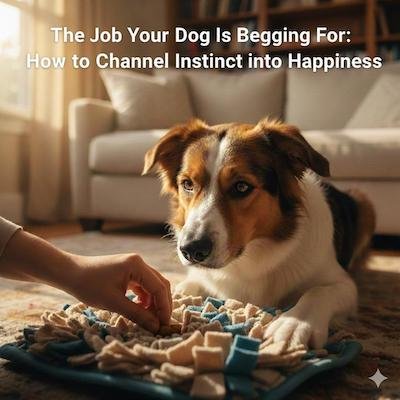
For the Nose-Driven Dog (Beagles, Dachshunds, almost all dogs actually): Scent work is the ultimate job. Start by hiding high-value treats in increasingly difficult places. Use commands like "Find it!" This tires the brain exponentially faster than a physical run.
For the Mouth-Oriented Dog (Labs, Goldens, Spaniels): Structured retrieving is the job. Instead of mindless fetch, teach a solid "hold," "drop," and directional retrieve. Use a specific toy that only comes out for this "work shift." You’ll be amazed at what your dog can do if taught properly.
For the Watchful Guardian (German Shepherds, Rottweilers, Dobermans): Formalize their role. Teach a "place" command on a mat near a window. Their job is to go to "place" and be calm, observing the environment on your terms, not reacting chaotically.
For the Clever Problem-Solver (Poodles, Shelties, mixed breeds): Puzzle toys and trick training are their job. Teach complex tricks in steps (get a tissue, close a drawer). Feed meals exclusively through puzzle feeders or Kong-type toys.
[This article is original content created by USA Dog Behavior (https://www.usadogbehavior.com) and is intended for our readers.]
Your 3-Step Framework to Start Today
Identify the Drive: What does your dog naturally love? Sniffing everything? Carrying toys? Watching the yard? That's your clue.
Build the Routine: Integrate a handful of 5-10 minute "job sessions" into your day. Before breakfast or after the evening walk is perfect. Consistency is key. Don’t go beyond this time period, or you risk your dog losing interest. Dogs, while smart, don’t have long attention spans.
Start Simple, Celebrate Success: If the job is "find it," start with treats in plain sight. Gradually increase difficulty. Always end on a win with happy praise. The goal is focused effort, not frustration. This concept is key!
Remember, you are primarily engaging your dog’s mind. You’re mentally stimulating them.
The Result: A Transformed Relationship
When you channel instinct into a job, you see a shift. The restless pacing stops. The obsessive barking lessens. You see a spark of focus and pride in your dog's eyes. You're not just a provider anymore; you're a partner and a guide.
Here’s possibly the best part of engaging your dog in this way: you will have a blast doing it and it will enhance your relationship with your dog.
The happiest dogs aren't the ones with the most idle time; they're the ones whose minds and instincts are respectfully and appropriately engaged. Start small, observe your dog's natural talents, and give them the meaningful work they are truly begging for.
For the audio version of these blog posts, tune into the USA Dog Behavior Podcast.
© 2025 Scott Sheaffer. All rights reserved. Original content. Reproduction prohibited.