
Is Your Neutered Dog "Hormonally Bankrupt?" The New Science of Canine HRT

Is Your Neutered Dog "Hormonally Bankrupt?"
Prefer listening? This post is also available as an episode on the USA Dog Behavior Podcast - don't forget to subscribe while you're there if you haven't already.
The Missing Piece in Your Dog’s Behavioral Puzzle
For decades, the "responsible" thing to do was to neuter our male dogs early. We were told it prevented health issues and would make them calmer. But as veterinary science evolves, we are discovering a hidden side effect: a condition some experts call "Spay-Neuter Syndrome." When we remove a dog’s testes or ovaries, we aren't just stopping reproduction; we are changing their endocrine system.
The Testosterone Gap
Testosterone is far more than a reproductive hormone in dogs. In mammals, it is a vital "well-being" hormone. It maintains muscle mass, bone density, and, crucially for behavior, it provides the neurochemical foundation for confidence and emotional stability.
According to data from Dogosterone.com and recent studies published in BMC Veterinary Research, nearly 25% of neutered dogs may suffer from the effects of low testosterone. While we often look at behavior as a training issue, sometimes the "engine" is simply running without oil.
Behavioral Symptoms of Low Testosterone

In my work as a dog behaviorist, I sometimes see male dogs, especially older ones, that are "irrationally" fearful with no apparent cause. They aren't just cautious; they are anxious, reactive, and lack the resilience to bounce back from stress. Common behavioral markers include:
Increased noise phobias (thunder, fireworks).
Generalized anxiety or "clinging" to owners.
Fear-based aggression toward strangers or other dogs.
Lethargy and a lack of "zest" for life.
[This article is original content created by USA Dog Behavior (https://www.USADogBehavior.com) and is intended for our readers.]

The Physical Connection
In some cases, this may not just be in their heads. Low testosterone leads to muscle atrophy, joint laxity, and a higher risk of CCL tears and hip dysplasia. When a dog’s body feels weak or painful, their "fight or flight" response can be heightened as well. They perceive that they can’t physically defend themselves, so they may become more reactive to perceived threats.
What is Canine HRT (Dogosterone™)?
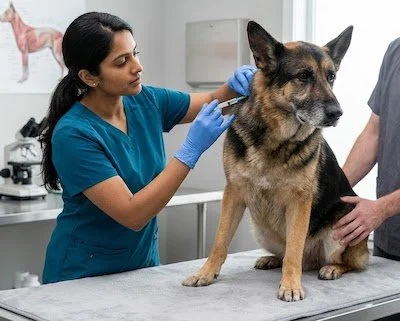
Pioneered by Dr. David Bieber, Dogosterone™ therapy involves precisely dosed testosterone injections (typically weekly or bi-weekly) to restore physiological levels. This isn't about creating "macho" dogs or "steroid" bulk; it’s about returning the dog to a state of biological balance.
Research from the Parsemus Foundation has shown that restoring these levels can significantly reduce luteinizing hormone (LH) levels. In neutered dogs, LH can skyrocket to 30 times its normal level because the body is constantly "screaming" for the testosterone that isn't there. High LH is increasingly linked to chronic inflammation and even certain cancers.
Is It Right for Your Dog?
If your neutered male dog has persistent anxiety, fear-based reactivity, or physical slowing that hasn’t responded to traditional behavior modification from a qualified dog behaviorist and hasn’t responded to behavioral medication, a hormonal panel might be the missing link.
Cautionary Note
While it would be nice to think that all neutered male dogs’ behavior issues could be remedied by simply starting them on HRT, it is never that simple. Behavior issues are learned behaviors in most cases, and simply starting HRT (or behavioral medication, for that matter) won’t magically “fix” your dog. However, it might possibly provide a variable that could assist in the overall treatment of your dog.
Are spayed female dogs affected in the same way?
It is important to note that a similar "hormonal bankruptcy" can occur in spayed females too. When we remove the ovaries, we also eliminate the primary source of estrogen and progesterone, leading to a massive surge in luteinizing hormone (LH) that can reach levels 30 times higher than normal. This endocrine shift, often referred to as "spay-neuter syndrome", can manifest in females as increased environmental reactivity, "spooky" behavior, and physical issues like muscle loss or coat changes. While the symptoms may look different across the sexes, the root cause remains a biological imbalance that traditional behavior modification alone may not be able to resolve in some cases.
While testosterone replacement is the "hot topic" for males right now, some forward-thinking vets are beginning to look at low-dose hormone restoration for females who show extreme anxiety or physical decline after spaying. However, because estrogen is more "biologically active" in terms of side effects (like bone marrow suppression if dosed incorrectly), it requires even tighter veterinary oversight than testosterone.
Wrap-Up
Hormone replacement therapy is a paradigm shift in how we view canine health and behavior. By treating the biological root cause rather than just the behavioral symptoms, we might be able to offer our dogs an increased level of confidence and physical comfort. Always work with a certified veterinarian to ensure a safe, monitored protocol if you choose to pursue this with your dog. Your dog’s "behavioral issues" might have another variable that needs to be considered.
Prefer listening? This post is also available as an episode on the USA Dog Behavior Podcast - don't forget to subscribe while you're there if you haven't already.
© 2026 Scott Sheaffer. All rights reserved. Original content. Reproduction prohibited.