Why Does My Dog Bark at Other Dogs?
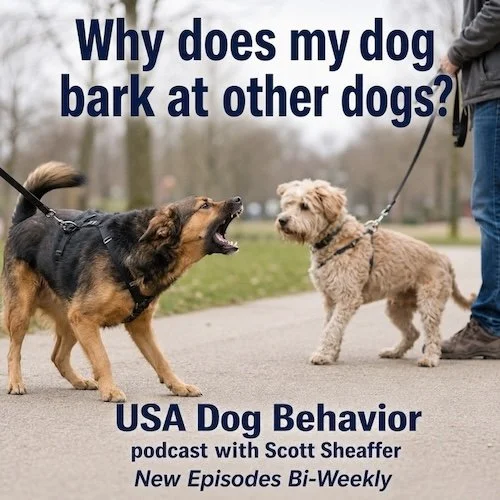
Prefer listening? This post is also available as an episode on the USA Dog Behavior Podcast—don't forget to subscribe while you're there if you haven't already.
One of the most common questions I hear from dog owners is, “Why does my dog bark at other dogs when we’re out walking?” Your dog may appear perfectly calm at home. Then another dog comes into view and suddenly they’re barking, lunging, pulling on the leash, and acting as if they’ve completely lost control. It can be embarrassing, frustrating, and even a little frightening.
The good news is that this behavior usually isn’t random. In fact, one of the most important concepts in dog behavior is this: the barking isn’t the problem—it’s information. The barking tells us your dog is experiencing something emotionally. If we can understand why it’s happening, we’re much closer to finding an effective solution.
What Is “Leash Reactivity”?
Many professionals refer to barking and lunging at other dogs while on leash as leash reactivity. That’s a perfectly acceptable description of what you’re seeing, but it’s important to understand that leash reactivity is a symptom and not a diagnosis. The real question is, “Why is my dog reacting?”
Fear Is Often the Real Reason
In my experience, the most common underlying cause is your dog’s fear or social insecurity around unfamiliar dogs. People are often surprised by this because their dog may look bold, loud, and even aggressive. In reality, most fearful dogs are simply trying to make the scary thing go away by acting aggressively. Barking, lunging, growling, and pulling are often very effective ways of telling another dog, “Stay away from me.” What appears to be confidence is frequently just a dog that’s worried.
Not every dog that barks at other dogs is fearful, however. Some dogs become frustrated because the leash prevents them from greeting another dog. Others become over-aroused by the excitement of seeing another dog. Less commonly, territorial behavior, previous negative experiences, pain, or true social conflict may play a role. That’s why understanding the why behind the behavior is so important. However, by far, the most common cause of dog to dog reactivity is fear based.
[This article is original content created by USA Dog Behavior (https://www.USADogBehavior.com) and is intended for our readers.]
Why the Behavior Gets Worse Over Time
Behavior that is repeatedly practiced becomes easier to perform. I often explain this to clients using one simple word: rehearsal.
Every time a dog barks and lunges at another dog, they are rehearsing that behavior. The more opportunities they have to practice it, the more automatic it can become. Your dog is becoming more experienced at responding that way. This has become their default behavior in the presence of other dogs. This is one reason early intervention is so valuable.
Also consider that every time your dog acts aggressively toward another dog on a walk, he is rewarded. They are rewarded because the other dog always moves on down the road; your dog thinks his aggressive behaviors have caused this departure. This is reinforcement for the behavior and also causes it to get worse.
Can Punishment Make It Worse?
Sometimes owners try to stop the barking by yelling, jerking the leash, or using punishment-based equipment. While these approaches may temporarily interrupt the barking, they fail to address the underlying emotional state.
If the barking is being driven by fear, adding punishment can actually increase your dog’s anxiety. Imagine being afraid of spiders and getting shocked every time one appeared. You probably wouldn’t become less afraid of spiders. You’d likely become even more anxious whenever you saw one. The same principle can apply to dogs.
Our goal isn’t simply to suppress barking. Our goal is to change how your dog feels about the situation.
What Does Effective Treatment Look Like?
The current standard of care for many fear-based behavior problems involves carefully planned desensitization and counterconditioning. Although those terms sound complicated, the concept is straightforward.
Your dog is gradually exposed over time to other dogs at a distance where they can remain reasonably calm while something they truly enjoy—usually high-value food—is consistently paired with seeing the other dogs. Over time, many dogs begin to associate the presence of other dogs with positive experiences rather than anxiety.
This process should always be structured so your dog can succeed. Simply forcing repeated close encounters or hoping your dog “gets used to it” makes the problem worse.
Five Common Mistakes Owners Make
While every dog is different, I commonly see these mistakes:
Moving too close to other dogs because they believe exposure alone will solve the problem.
Waiting until the dog is already barking before trying to intervene.
Tightening the leash the moment another dog appears, which can increase tension.
Trying to punish the barking instead of understanding why it’s happening.
Allowing repeated barking episodes, giving the dog more opportunities to rehearse the unwanted behavior.
When Should You Seek Professional Help?
If your dog is barking, lunging, growling, or becoming increasingly difficult to manage around other dogs, it’s worth having the behavior evaluated by someone who is competent to do so.
An experienced canine behavior professional can help determine why the behavior is occurring, assess the level of risk, discuss prognosis, and develop recommendations that fit both your dog and your lifestyle. Remember, the barking itself isn’t the diagnosis. It’s simply your dog’s way of communicating something important.
Wrap-Up
If your dog barks at other dogs on walks, don’t assume they’re being stubborn, dominant, or spiteful. More often than not, they’re communicating an emotional response that deserves thoughtful evaluation.
Your dog’s behavior always has a reason. Find the reason, and you’re much closer to finding the solution.
Prefer listening? This post is also available as an episode on the USA Dog Behavior Podcast—don't forget to subscribe while you're there if you haven't already.
© 2026 Scott Sheaffer. All rights reserved. Original content. Reproduction prohibited.