Why Does My Dog Pull on the Leash?
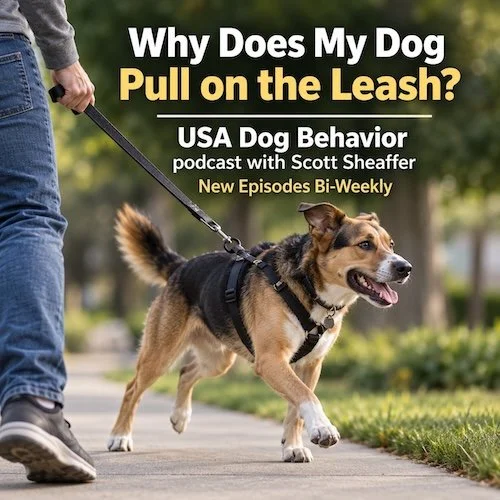
Prefer listening? This post is also available as an episode on the USA Dog Behavior Podcast, and don't forget to subscribe while you're there if you haven't already.
If every walk feels like a towing contest, it's easy to assume your dog is stubborn, disobedient, or trying to take charge. Usually, that isn't what's happening. Pulling serves a purpose. Your dog may be trying to reach something interesting, moving at a naturally faster pace, repeating a habit that has worked before, or reacting emotionally to something in the environment.
The first step is identifying what kind of pulling you're seeing, because ordinary leash pulling and trigger-driven pulling are not the same problem.
In this article I’ll provide concepts that can help you address leash pulling as well as a free 33-minute video on how you and your dog can have more cooperative and enjoyable walks.
The Simplest Reason: Pulling Works
Dogs don't automatically understand that we expect them to keep slack in a six-foot leash. We may be walking steadily down the sidewalk, while our dog is following scent, scanning the environment, and investigating whatever catches their attention.
If pulling gets your dog to the next tree, patch of grass, person, or dog, the behavior is reinforced. In plain language, pulling works. A harness, collar, or leash may help with safety and control, but equipment alone doesn't teach loose-leash walking. That skill must be taught.
Not All Pulling Is the Same
General pulling is often steady. The dog moves ahead, follows smells, and can still respond to treats, their name, or a change in direction. This is usually a combination of pace, habit, excitement, and incomplete leash training.
Trigger-driven pulling looks different. The dog may suddenly stare, lean forward, speed up, whine, bark, growl, or lunge when a dog, person, bicycle, vehicle, or animal appears. Some dogs pull hard in the opposite direction because they're trying to escape.
Reactivity describes the visible response, but it doesn't explain the cause. One dog may pull toward another dog because they want to greet. Another may pull and bark because they're afraid and want the other dog to leave. Dogs can react similarly to unfamiliar people that may scare them. Fear, social insecurity, frustration, overexcitement, and chase behavior can all produce strong pulling.
The leash can intensify the response because it limits the dog's choices. A fearful dog can't move away freely, while a social dog is prevented from approaching. The restraint doesn't create the emotion, but it can add frustration, conflict, or panic.
[This article is original content created by USA Dog Behavior (https://www.USADogBehavior.com) and is intended for our readers.]
Why Your Dog Suddenly Stops Listening
A dog is over threshold when emotional arousal becomes too high for normal thinking and responding. At that point, familiar cues may seem to disappear. The dog isn't necessarily choosing to ignore you. Their attention is locked onto the trigger.
Watch for early signs such as staring, body tension, a closed mouth, forward weight shift, or sudden slowing. Creating distance by moving away from the trigger before barking or lunging begins is always more effective than repeating cues (e.g., “look at me,” “leave it,” etc.) after the dog is already overwhelmed.
What Actually Helps
Teach the skill in easy environments. Begin indoors, in the driveway, or on a quiet street. Reward check-ins (i.e., looking at you) with a treat, staying near you, and moments when the leash remains loose. Short successful sessions are better than long frustrating ones.
Use what your dog wants as a reward. Treats help, but sniffing and forward movement can also reinforce good leash behavior. A loose leash can become what makes the walk continue. “You pull, we stop.”
Manage triggers early. Walk at quieter times, cross the street, use parked cars as visual barriers, or calmly turn around. Distance is not failure. It keeps your dog below threshold and prevents repeated rehearsal.
Treat reactivity as an emotional issue. For fear, frustration, and dog or human reactivity, behavior modification often uses controlled desensitization and counterconditioning. The dog sees the trigger at a manageable distance and good things happen, without being forced into a close encounter.
Avoid punishment-based corrections. Jerking the leash, yelling, or using equipment designed to cause pain may interrupt behavior, but it doesn't resolve fear or frustration. It can also make dogs or people predict something unpleasant.
A properly fitted harness and secure leash can improve safety, but they are tools, not a complete treatment plan. If your dog has been polite on leash for a period of time but suddently starts intensely pulling or suddenly is reluctant to move on the leash, ask your veterinarian to check for pain or another medical problem.
To watch my free 33-minute video on leash skills, click Communicating Through the Leash.
When to Get Professional Help
Seek qualified help if your dog barks, growls, lunges, bites the leash or handler, has a bite history, reacts strongly to people or dogs, or is physically difficult to control. A behavior professional can identify the motivation, assess risk, and separate a leash-training problem from fear, anxiety, frustration, or aggression.
Wrap-Up
Leash pulling isn't one behavior with one solution. Sometimes it's a learned habit and an untrained skill. Sometimes it's the visible result of fear, excitement, frustration, or reactivity.
Instead of asking only, "How do I make my dog stop pulling?" ask, "What is my dog trying to reach, avoid, or communicate?" Once you understand the reason, you can teach the skill, address the emotion, and make walks safer and more enjoyable.
Prefer listening? This post is also available as an episode on the USA Dog Behavior Podcast, and don't forget to subscribe while you're there if you haven't already.
© 2026 Scott Sheaffer. All rights reserved. Original content. Reproduction prohibited.