





Scott's 60-Second Video Dog Tip: Do Dogs Protect Their Owners?
A question I'm asked all the time is whether dogs protect their owners. Get the answer in this 60-second video.
Read More
Search blog
Why do some dogs become aggressive? Learn the real causes behind aggression, including fear, anxiety, pain, frustration, genetics, and learned behavior.
Most dog behavior issues aren’t obedience problems; they’re misunderstood dog behavioral patterns. Learn what you’re missing and how it affects your dog’s behavior.
Some common dog training advice sounds right—but actually makes behavior worse. Learn the 3 biggest mistakes and what to do instead.
Discover how Dogosterone and canine HRT can resolve fear-based behavior, anxiety, and mobility issues in neutered male dogs. Is your dog hormonally imbalanced?
Dog owners often unintentionally cue fear and aggression in their dogs. Learn how subtle human behaviors can trigger reactivity—and what to do instead.
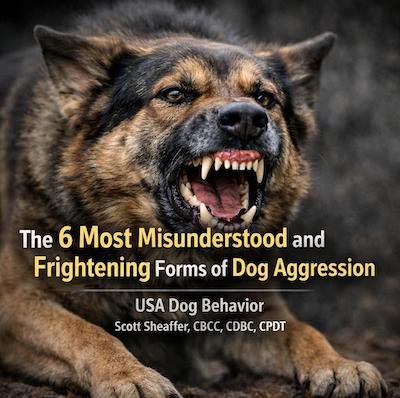
Discover six rare and often misunderstood types of dog aggression, including sleep startle, redirected aggression, and predatory behavior toward humans. Learn why professional help is critical.
Do dogs go to heaven? A pan-religious look at what Christianity, Islam, Judaism, and Eastern traditions say about pets and the afterlife, plus personal reflections on grief, the Rainbow Bridge, and the book Dog Heaven by Cynthia Rylant.
Do dogs know when another dog dies? Learn how dogs perceive death, why they react differently, and how to help surviving dogs adjust after a loss.
Uncover the truth behind dog aggression. Learn why barking, lunging, or snapping is a symptom of fear, not a "mean" personality. Discover the 7 common types of dog aggression and how understanding triggers leads to effective behavior modification, not just labeling.
Worried about your dog and new baby? Discover the reassuring truth: dogs rarely see babies as prey. Learn the key safety periods, how dogs truly perceive infants, and actionable steps for a harmonious home.
Standard dog training often worsens fear and anxiety in sensitive dogs. Learn why obedience-based methods fail anxious dogs—and what actually helps.
About ScottScott Sheaffer, CBCC-KA, CDBC, CPDT-KA, is a certified dog behaviorist. Scott specializes in the assessment and treatment of fear, anxiety, aggression and phobias in dogs six months and older. Learn More |
Subscribe (Free) to Scott's BlogExplore & Subscribe |
A question I'm asked all the time is whether dogs protect their owners. Get the answer in this 60-second video.
Read MoreThe question as to whether or not you should repeat a command to a dog is one I am asked all of the time. Put a group of dog trainers together and ask them this question and you won’t get 100% agreement. For this article I will use the word “command”, but dog behavior consultants and specialists almost exclusively use the word “cue” for a number of reasons.
Read MoreThings had changed for Patches (not his real name) by the time I saw him. But let me start at the beginning. Patches is an All American dog of many breeds it seems – and he is beautiful. The original owner had to surrender Patches to a rescue organization because of her failing health. She could no longer take care of Patches.
Read MoreThere are things in life you have to experience to understand. Your first love. A first child. Your once-in-a-lifetime dog. If you have to ask, “What’s a once-in-a-lifetime dog?” you haven’t had one yet. And, by the way, you only get one. The Dog Gods deem it so.
Read MoreDog owners sometimes notice their dog appears sad or listless and wonder if dogs can get depressed in the same way that humans get depressed. The short answer to this question is “yes”. Dogs can get depressed in ways that are similar to human depression.
Read MoreYou’ve noticed that your dog appears to like some people more than others. Even if your dog sometimes shows aggressive tendencies toward people, he or she might not be bothered with certain people. Why is this?
Read MoreSome dog behaviorists, behavior consultants and behavior specialists will not take their personal dogs to dog parks – ever. I am not one of those people. If you use some common sense and follow the guidelines below, you and your dog can both have a fun and stimulating time at the dog park.
Read MoreI’ve witnessed too many dogs unnecessarily suffer because of misunderstandings about dog behavior. These misunderstandings are seen everyday in dog owners and even some dog trainers. It’s just a lack of knowledge about dogs for the most part; the following might shed some light on some of the most common misconceptions.
Read MoreHere is a list of 4 items presented in order of least important to most important of things that can greatly improve your veterinarian’s relationship and effectiveness with your dog.
Read MoreThere are 15 principles in the dog behavior world I find myself repeating on a daily basis. Understanding and acknowledging these truths will greatly improve the relationship we have with our dogs. I’ve outlined these concepts below.
Read More“When should I euthanize my dog?” is a question I’m frequently asked. I make it my policy to never tell dog owners if or when they should euthanize their dog. Please remember, no one can make this decision for you – not a dog trainer, not a behaviorist, not a veterinarian, no one. This is a decision that is ultimately best made by a loving owner.
Read MoreSome dog owners feel they shouldn’t have to reward their dog for doing certain expected behaviors. They tell me they’re already paying for their dog’s vet bills, food and housing – that should be enough to get their dog’s loyalty.
Read MoreDogs can become fearful of many things through no fault of their own. Examples include: noises, riding in cars, touch, veterinarians, animate and inanimate objects, etc. The list is virtually endless.
Read MoreThere are numerous laws regarding dog bites. One that is important for dog owners to be aware of is known as the "one bite rule". Simply stated, the one bite rule means that dog owners have limited liability the first time their dog bites a human (this rule does not apply to dog-dog bites).
Read MoreThe state of affairs in defining and regulating service dogs is in flux to say the least – it’s the Wild West. Governmental entities, including the federal government, are looking at ways to more tightly control the definition and use of these dogs.
Read MoreThere are probably a number of reasons why the population growth rate of California has continued to decline over the last 30 years (1). Excessive government regulation is one of the reasons that is frequently cited.
Read More
Why do some dogs with aggression, fear, anxiety, and reactivity improve while others struggle? Dog behaviorist Scott Sheaffer explains the four owner-related factors that strongly predict success in difficult canine behavior cases.