












Why Dogs Bite “Out of Nowhere”
We’ve all heard some version of the following, “That dog bit me out of nowhere.” The person is talking about a dog who appeared to be at ease and then suddenly and without warning bit that individual.
Read More
Search blog
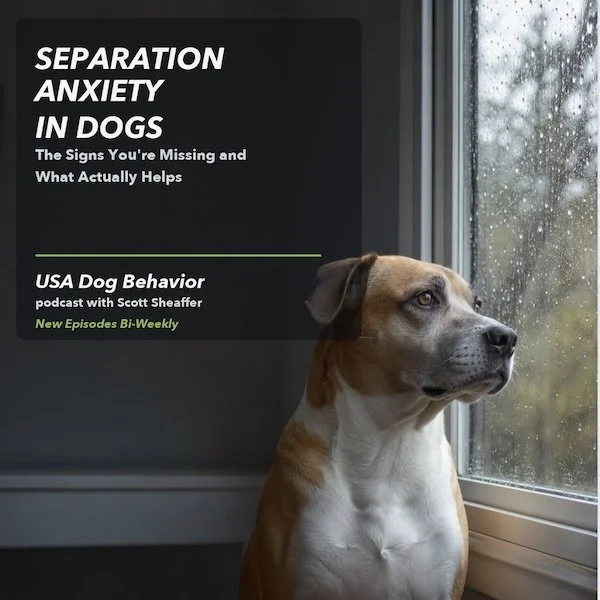
Learn the signs of separation anxiety in dogs, how to tell it from boredom, and the practical, humane steps that can help your dog feel safer alone.
Does your dog bark and lunge at other dogs on walks? Learn why this behavior happens, what it really means, common mistakes to avoid, and how behavior modification can help.
A true story about a loving dog owner named Tim, a rescue dog named Buddy that repeatedly bit him, and the surprising discovery that changed everything. Learn why understanding canine body language can prevent bites and strengthen your relationship with your dog.
Why do some dogs with aggression, fear, anxiety, and reactivity improve while others struggle? Dog behaviorist Scott Sheaffer explains the four owner-related factors that strongly predict success in difficult canine behavior cases.
Why do some dogs become aggressive? Learn the real causes behind aggression, including fear, anxiety, pain, frustration, genetics, and learned behavior.
Most dog behavior issues aren’t obedience problems; they’re misunderstood dog behavioral patterns. Learn what you’re missing and how it affects your dog’s behavior.
Some common dog training advice sounds right—but actually makes behavior worse. Learn the 3 biggest mistakes and what to do instead.
Discover how Dogosterone and canine HRT can resolve fear-based behavior, anxiety, and mobility issues in neutered male dogs. Is your dog hormonally imbalanced?
Dog owners often unintentionally cue fear and aggression in their dogs. Learn how subtle human behaviors can trigger reactivity—and what to do instead.
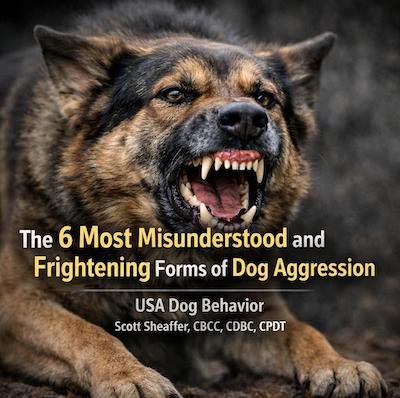
Discover six rare and often misunderstood types of dog aggression, including sleep startle, redirected aggression, and predatory behavior toward humans. Learn why professional help is critical.
Do dogs go to heaven? A pan-religious look at what Christianity, Islam, Judaism, and Eastern traditions say about pets and the afterlife, plus personal reflections on grief, the Rainbow Bridge, and the book Dog Heaven by Cynthia Rylant.
Discover five common dog-owner habits that create stress, confusion, and behavior problems, plus humane, practical ways to help your dog succeed.
Learn the signs of separation anxiety in dogs, how to tell it from boredom, and the practical, humane steps that can help your dog feel safer alone.
Does your dog bark and lunge at other dogs on walks? Learn why this behavior happens, what it really means, common mistakes to avoid, and how behavior modification can help.
A true story about a loving dog owner named Tim, a rescue dog named Buddy that repeatedly bit him, and the surprising discovery that changed everything. Learn why understanding canine body language can prevent bites and strengthen your relationship with your dog.
Why do some dogs with aggression, fear, anxiety, and reactivity improve while others struggle? Dog behaviorist Scott Sheaffer explains the four owner-related factors that strongly predict success in difficult canine behavior cases.
Why do some dogs become aggressive? Learn the real causes behind aggression, including fear, anxiety, pain, frustration, genetics, and learned behavior.
Most dog behavior issues aren’t obedience problems; they’re misunderstood dog behavioral patterns. Learn what you’re missing and how it affects your dog’s behavior.
Some common dog training advice sounds right—but actually makes behavior worse. Learn the 3 biggest mistakes and what to do instead.
Discover how Dogosterone and canine HRT can resolve fear-based behavior, anxiety, and mobility issues in neutered male dogs. Is your dog hormonally imbalanced?
Dog owners often unintentionally cue fear and aggression in their dogs. Learn how subtle human behaviors can trigger reactivity—and what to do instead.
Discover six rare and often misunderstood types of dog aggression, including sleep startle, redirected aggression, and predatory behavior toward humans. Learn why professional help is critical.
Do dogs go to heaven? A pan-religious look at what Christianity, Islam, Judaism, and Eastern traditions say about pets and the afterlife, plus personal reflections on grief, the Rainbow Bridge, and the book Dog Heaven by Cynthia Rylant.
Do dogs know when another dog dies? Learn how dogs perceive death, why they react differently, and how to help surviving dogs adjust after a loss.
Uncover the truth behind dog aggression. Learn why barking, lunging, or snapping is a symptom of fear, not a "mean" personality. Discover the 7 common types of dog aggression and how understanding triggers leads to effective behavior modification, not just labeling.
Worried about your dog and new baby? Discover the reassuring truth: dogs rarely see babies as prey. Learn the key safety periods, how dogs truly perceive infants, and actionable steps for a harmonious home.
Standard dog training often worsens fear and anxiety in sensitive dogs. Learn why obedience-based methods fail anxious dogs—and what actually helps.
Is your dog bored or anxious? Learn why 'giving your dog a job' is the key to channeling natural instincts, stopping bad behavior, and creating a happier, more fulfilled canine companion. Practical tips inside.
Bringing home a new dog is exciting, but first-time owners often discover the learning curve is steeper than they expected. After working with hundreds of families, I’ve noticed I approach first-time owners very differently than experienced ones — not because they aren’t intelligent, lack commitment or care, but because they’re working from assumptions that just don’t match how dogs actually learn.
We’ve all seen them—the modern “training” collars that promise a quick fix for all kinds of dog behavior problems. These collars are really just old-school shock collars (also called e-collars) with a built-in buzzer. While the electric shock function is increasingly recognized as aversive and inhumane, many well-intentioned dog owners are drawn to the “buzzer” or “vibration-only” mode. It seems like such a harmless beep or gentle nudge, a simple way to get your dog’s attention.
Barking is one of the most natural things a dog can do—but when it becomes constant in the backyard, it can strain relationships with neighbors and even cause stress for the dog. The key is to understand why your dog is barking and then take steps to make things quieter and calmer for everyone.
Here are eight ways to stop your dog’s backyard barking:
You’ve seen it a hundred times: one minute, your dog is a perfect angel. The next, they’re a blur of fur, tearing laps around the coffee table, skidding across the floor with a wild look in their eyes. It’s a scene of pure, unbridled chaos… and it’s completely normal.
Aggression is the number-one reason dog owners reach out to me. It’s also one of the most emotionally charged and misunderstood behavior problems. When someone says, “My dog bit me,” or “My dog bit someone,” fear and frustration often take over—and myths quickly fill the gaps where knowledge is missing.
People often ask me, “Scott, what’s the number one thing I should pay attention to in my dog’s behavior?” It’s a fair question. As dog owners, we’re told to keep up with diet, exercise, training, socialization, enrichment, vet visits, and the list goes on and on. All of that matters.
When people ask me, “Who makes the best dog owner?” they usually expect me to name a type of person. Maybe someone who works from home or someone with a big fenced yard. Maybe they’re thinking about people who had dogs as kids and grew up knowing all the basics.
But the truth is, none of those things guarantee success. I’ve seen dogs thrive in apartments and struggle in sprawling houses with massive backyards. I’ve met first-time dog owners who completely turned a difficult case around, and I’ve seen seasoned dog people miss the mark.
When a dog shows aggression, it’s natural to want the problem solved quickly. Many owners, hoping for a fresh start, turn to “board and train” programs—where a dog lives at a training facility for days or weeks, receiving daily sessions with a trainer.
It sounds ideal: the trainer “fixes” the problem while you go about life, and you get your dog back transformed. Unfortunately, for aggression cases, the reality can be far more complicated—and in some cases, harmful.
I want to talk about something a lot of dog owners overlook, but it can make a huge difference in housetraining and behavior issues—properly cleaning up dog accidents. Whether you're dealing with a young puppy or a dog who’s marking in the house, the way you clean up after them matters more than most people realize.
Why Scent Matters More Than the Mess
When dogs eliminate inside, it’s not just an accident; it’s communication. Dogs use scent the way we use text messages. Whether urine or feces, it leaves a calling card: “Hey, this is a place where I go.” And if that message doesn’t get fully erased, your dog might keep going back and “resending” that message.
Deciding to euthanize a dog for behavior reasons is one of the most painful choices a dog owner can face. Unlike terminal illness, where the outcome is clear, behavioral euthanasia involves weighing quality of life, safety risks, and ethical responsibility.
As a dog behavior expert, I’ve seen cases where euthanasia was the last—but kindest—option. Let’s discuss when it might be appropriate and how to navigate this emotional and difficult decision.
Cesar Millan, it’s time to apologize to dogs. For years, you’ve pushed these four myths, and now, science is calling for a reckoning.
If you’ve ever watched The Dog Whisperer, you’ve seen Cesar Millan in action, calmly walking a pack of dogs, correcting bad behavior with a sharp "tsst," and preaching about "dominance" and "being the pack leader." His methods look effective on TV, but here’s the problem: most of what he promotes isn’t backed by modern dog behavior science. In fact, some of it is downright harmful.
We all think we know what punishment looks like when it comes to dogs. Ask most people, and they’ll say, “Oh yeah, that’s stuff like hitting, spanking, shock collars, jerking the leash, or prong collars.” And yes, those are all forms of punishment—but they’re not the whole story.
Aggression in dogs is a complex behavior that normally stems from fear rather than inherent hostility. Understanding the root cause of aggression is crucial for effective management and rehabilitation.
Fear is the primary driver of aggressive behavior in dogs. When a dog perceives a threat—be it a person, another dog, or an unfamiliar object—it may react aggressively to protect itself.
About ScottScott Sheaffer, CBCC-KA, CDBC, CPDT-KA, is a certified canine behavior consultant specializing in the assessment of serious canine behavior problems. Learn More |
Subscribe (Free) to Scott's BlogExplore & Subscribe |
We’ve all heard some version of the following, “That dog bit me out of nowhere.” The person is talking about a dog who appeared to be at ease and then suddenly and without warning bit that individual.
Read MoreMany dog lovers have multiple dogs in their homes - including me. However, as with just about everything in life, too much of a good thing can be problematic sometimes. Actually, math is the problem. The specific math formula (I promise no further math after this) is: nCr = n!/r!(n-r)!
Read MoreTaking your dog for regular annual exams with your veterinarian is a New Year's resolution that may be more important than you previously realized. The reason your dog's annual exam is so critical is simple.
Read MoreYou might think that dogs wouldn't have serious behavior issues regarding food, but just like humans, they do. I've provided information on three types below. "Doggie Table Manners Gone Bad" Compulsive disorders are manifested as repetitive behaviors that are excessively repeated for no apparent reason (think OCD in humans).
Read MoreDogs can be profoundly resilient both physically and emotionally. They don't appear to hold grudges or consciously dwell on the past. This is why rescued dogs can make outstanding pets and severely injured dogs adapt so well to their handicaps.
Read MoreWhat implied promises do we make to our dogs when we bring them into our homes? This thought occurred to me recently while attending the wedding of a nice young couple (yes, I was paying attention to the ceremony). As I listened to their wedding vows, I realized that we essentially make these same kinds of "vows" to our dogs when they become part of our household.
Read MoreDog behavior specialists and behaviorists use a scale when assessing dog bites. This is essential when diagnosing aggression issues and providing a prognosis. There are many scales, but the one that is most commonly used is Dr. Ian Dunbar's Dog Bite Scale.
Read MoreI hear it every day, "My dog is dumb." To be sure, there are dogs that are, um, well, not as smart as others. However, almost all dogs are pretty bright and even the ones that aren't can do some pretty amazing things when taught using the correct methods.
Read MoreThe most common behavior issue I see is aggression. Below I've listed three major categories of dog aggression with a brief description. Fear Aggression. Simply stated, these dogs have learned and have been reinforced for using aggression as an offense-is-the-best-defense strategy for dealing with things that scare them.
Read MoreYes, dogs can have OCD (Obsessive Compulsive Disorder) that manifests as tail chasing, licking their paws until there is an injury (lick granuloma), fly snapping (biting at imaginary flies), flank and blanket sucking (literally sucking on their rear legs or on inanimate objects), pica (eating non-food items) and the list goes on.
Read MoreI was recently taking a walk with my wife, Barbara, at one of our favorite parks. We came upon an older couple that was sitting on one of the park benches with their two beautiful German Shepherds. I asked if it would be okay for us to approach their dogs. The husband replied, "No. They are highly protective of us. You know how German Shepherds are."
Read MoreHumans are incredibly resistant to letting go of long held beliefs - even when faced with evidence that should point us in a new direction. The following popular beliefs can get in the way of our relationship with our dogs and decrease our effectiveness when training them.
Read More"My dog, Chester, tears things up when I'm away at work. Today it was the drapes! I know he's doing this to get back at me for leaving him alone all day. When I come home he looks guilty and cowers."
Read MoreAs a professional dog behavior specialist, I long ago made the decision not to use prong, choke or shock collars. Let me tell you how I reached that decision.
Read MoreMen's Health magazine recently ran an article with some interesting facts about men and their dogs. Here a few of the more interesting. The percentage of men who don't have a dog, but wish they did is 88%.
Read MoreAs a dog trainer and behavior specialist, I'm frequently asked the following questions. "What do you think are the best breeds for a family dog?" Basset Hound - Friendly to people and pets - great with children too. Get one from rescue.
Read More
Discover five common dog-owner habits that create stress, confusion, and behavior problems, plus humane, practical ways to help your dog succeed.